
Dallas, Texas
Tree Removal and Tree Service in Dallas
Dallas protects trees through Article X of its development code, but owner-occupied single-family and duplex lots under two acres are exempt from the removal permit. For most homeowners the bigger issues are wind, clay soil and several species in decline.
- County
- Dallas (parts in Collin, Denton, Kaufman and Rockwall)
- Tree permits
- City of Dallas arborists, Development Services
- Key local rule
- Article X. Single-family and duplex lots under two acres are exempt from the removal permit.
- Electric utility
- Oncor
- Main hazards
- Straight-line wind, tornadoes, freezes, drought on expansive clay
Article X: who needs a permit and who does not
Article X of the Dallas Development Code regulates removal of protected trees, broadly those 8 inches or more in diameter that are not on the city's list of unprotected species.
The key exemption for homeowners is that no tree removal permit is required when the lot is smaller than two acres and contains a single-family or duplex use. The exemption does not apply to vacant lots, to lots of two acres or more, or to a lot where the house is being demolished. Builders clearing a lot fall under the full rules.
Species such as hackberry, Arizona ash, silver maple, Siberian elm, Chinese tallow and Bradford pear are on the city's unprotected list. Highland Park, University Park and suburbs such as Plano and Frisco have their own ordinances.
Wind is the main event in Dallas
On the night of October 20, 2019, an EF3 tornado tracked across North Dallas from near Love Field through Preston Hollow to Richardson, destroying mature canopy along some of the city's most heavily treed streets.
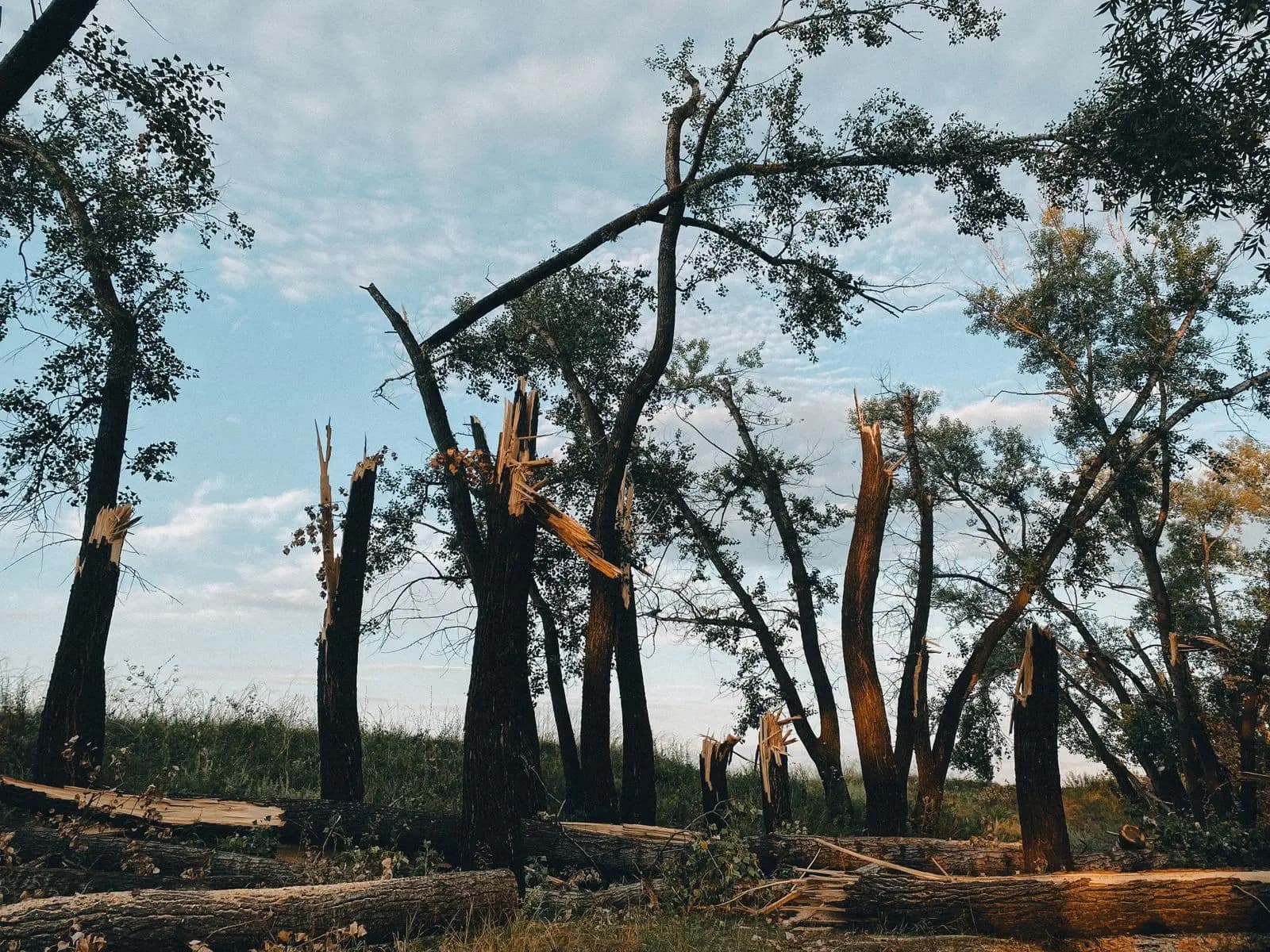
Far more often the damage comes from straight-line wind. On May 28, 2024, a morning storm complex with hurricane-force gusts knocked out power to hundreds of thousands of Oncor customers in Dallas County and left limbs and whole trees across streets from Oak Cliff to Lake Highlands.
The February 2021 freeze did quieter damage. Live oaks defoliated, and many palms, some oaks and marginally hardy ornamentals died back or died. Trees that never fully recovered are among those failing now.
Blackland clay, foundations and roots
Dallas sits on Blackland Prairie clay, one of the most expansive soils in the country. It swells when wet and shrinks deeply when dry, opening cracks wide enough to lose a tool in.
Two consequences follow for trees. Roots are broken by the movement and stay shallow, so large trees uproot more readily in wet-season storms. And trees near a house draw moisture from clay under the slab during drought, which foundation companies often cite as a factor in settlement.
If a foundation repair firm has recommended removing a tree, ask an independent engineer or arborist as well. A root barrier, or watering the foundation consistently, sometimes solves the problem and keeps the tree.
Dallas trees and what goes wrong with them
- Post oak
- Native remnant trees in East Dallas and Oak Cliff. Extremely sensitive to root disturbance and overwatering, and slow to show decline.
- Live oak
- The standard planted shade tree. Sound in wind, but subject to oak wilt and freeze defoliation.
- Shumard red oak
- A fast-growing shade tree, highly susceptible to oak wilt.
- Cedar elm
- Tough and well adapted. Watch for tight forks that split.
- Pecan
- Large trees along creeks and in older yards. Heavy limb drop.
- Arizona ash and Bradford pear
- Short-lived. Both are on the unprotected list and commonly removed by 25 to 30 years.
Emerald ash borer is in Dallas County
The insect was confirmed in Dallas County in 2022 after earlier finds in Tarrant County. Ash trees here are now at risk.
Canopy thinning from the top down
Often the first visible symptom.
D-shaped exit holes
An eighth of an inch across, in the bark.
Bark splitting and woodpecker damage
Birds strip bark to get at larvae.
Shoots sprouting from the trunk
A stress response as the crown dies.
Dead ash turning brittle fast
Remove dead ash promptly. See dead tree removal.
Timing tree work in North Texas
| Work | Best time | Why |
|---|---|---|
| Oak pruning | July to January | Avoids the February to June oak wilt risk period. Paint all cuts. |
| Planned removals | Late fall and winter | Lower demand and firm ground |
| Storm-prep pruning | Before March | Severe weather peaks April to June |
| Stump grinding | Any time the soil is not saturated | Grinders bog down in wet clay |
| Ash treatment for borer | Spring, by a licensed applicator | Systemic insecticides are taken up during active growth |
Services Dallas owners request
Dallas tree questions
Do homeowners need a permit to remove a tree in Dallas?
Not if the lot is under two acres and has a single-family or duplex use. Vacant lots, larger lots and demolition sites do need a permit for protected trees.
Is oak wilt in Dallas?
Yes. It is present in Dallas County and across North Texas. Avoid pruning oaks from February through June and paint every cut immediately.
Why is my post oak dying after we built the patio?
Post oaks do not tolerate soil compaction, grade changes, trenching or added irrigation in their root zone. Decline typically shows two to five years after the disturbance and is seldom reversible.
Does Oncor trim trees on my property?
Oncor's contractors prune trees near its distribution lines, including in rear easements. The service line to the house is generally the owner's responsibility.
Reach a tree service in Dallas
Call to be connected with an independent tree company that works in the Dallas area, or leave your number and one will call you back.
(888) 555-0142Call availability varies by area and time of day
Limbwright is a referral service. Your call or request goes to an independent tree service company that sets its own prices and schedule. Ask for proof of insurance and a written scope before work starts. How this works
Request a callback
Leave a number and a tree service provider in your area will call you.