
Downed power line, fire, gas smell or someone hurt? Call 911 first and stay at least 35 feet from any wire.
Storm cleanup
Storm Damage Tree Removal
Storm damage tree work starts with triage. Trees on structures and across access come first, hanging limbs and split trunks second, and everything else waits until the yard is safe to walk. Not every damaged tree needs to be removed.
Call availability varies by area and time of day. Calls are answered by an independent tree service provider.
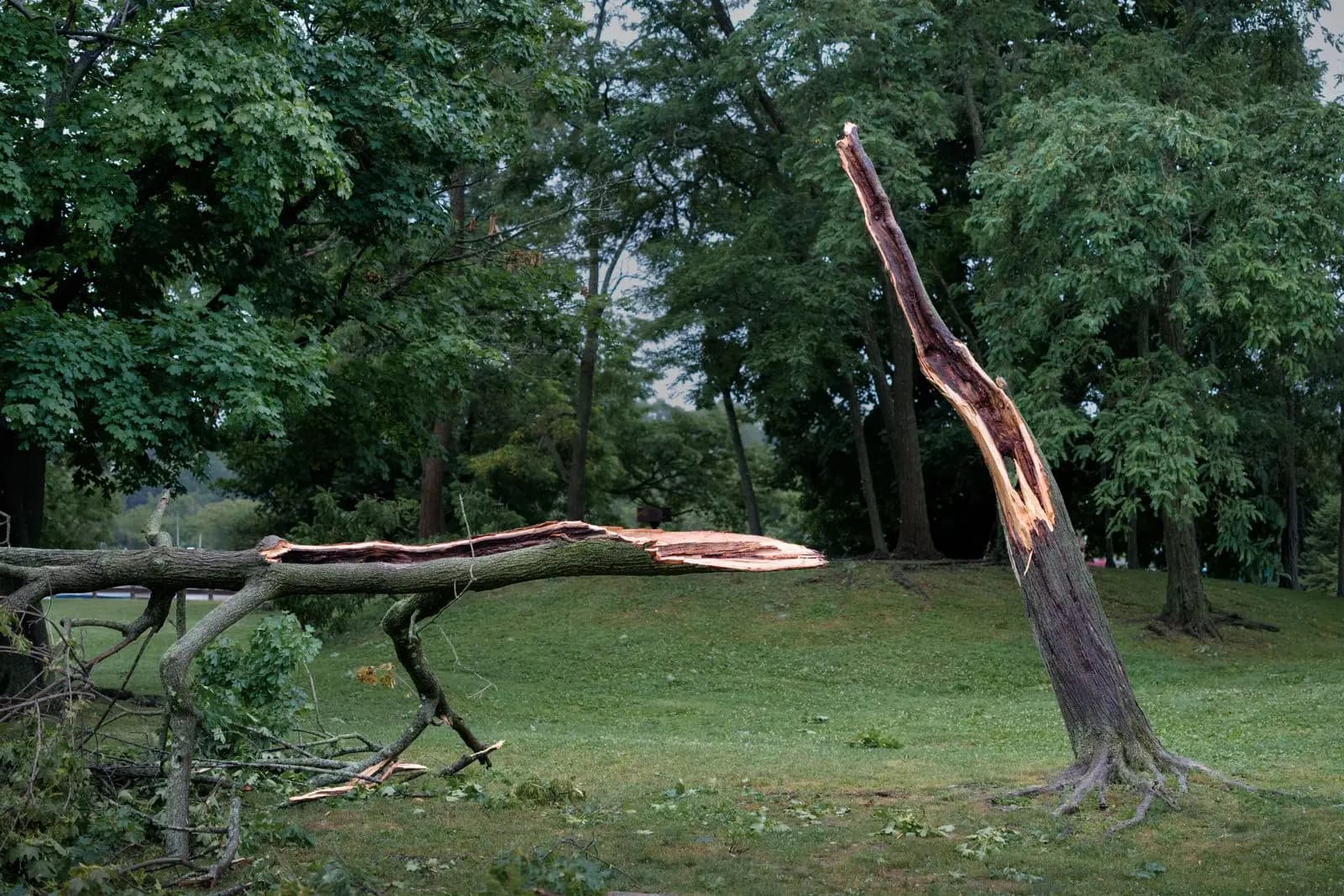
Reading a storm-damaged tree
Wind, ice and saturated soil break trees in a handful of recognizable ways. Each has a different outlook.
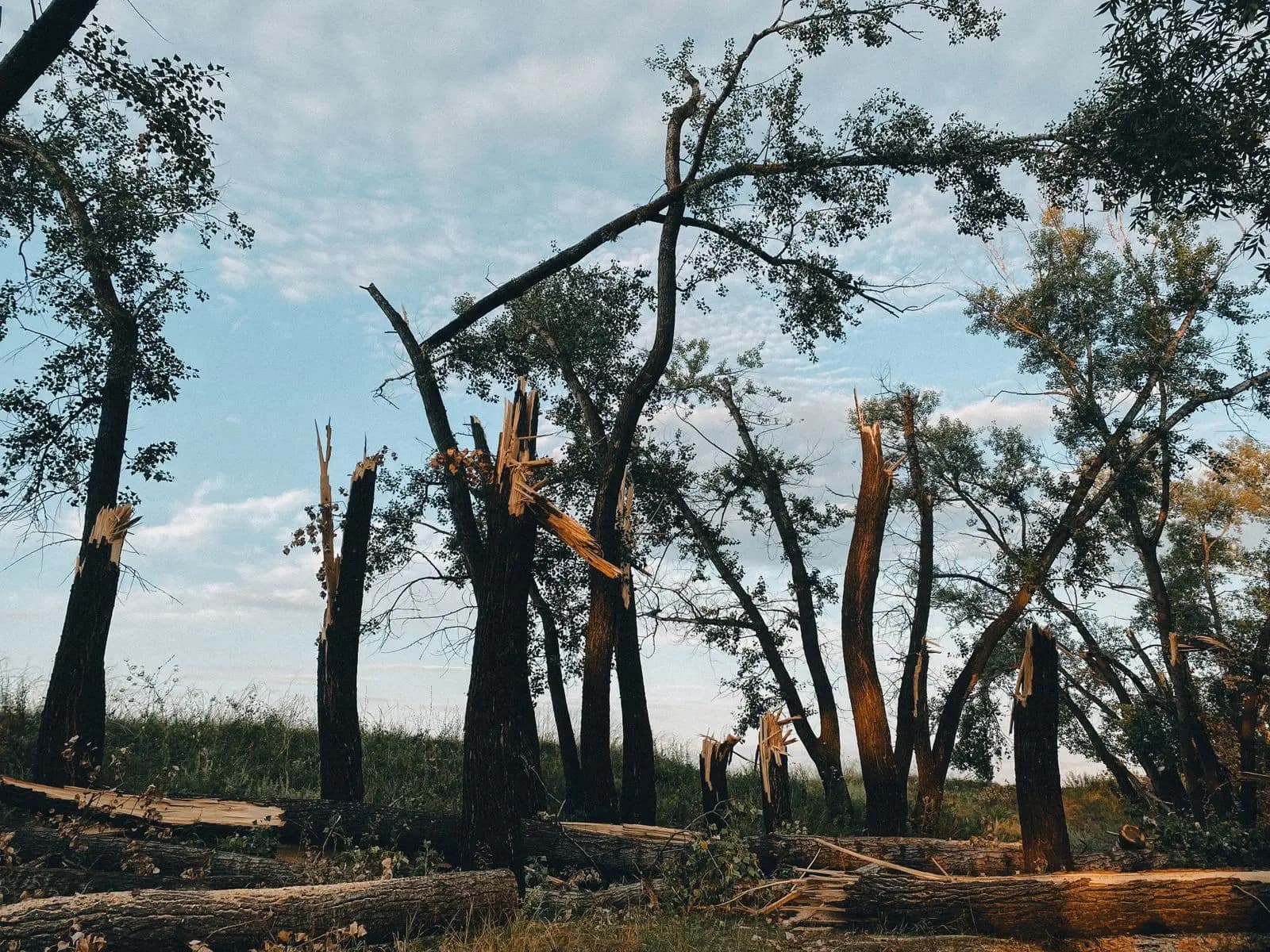
Broken branches are the most common and the most survivable. If the main trunk and most large limbs are intact, proper pruning cuts let the tree recover. A split where two stems meet is more serious, because the wound runs into the trunk. A snapped trunk leaves a standing spar that will not regrow into a sound tree. An uprooted or heaved tree has lost its anchorage, and with rare exceptions for small, recently planted trees it cannot be reset.
The damage you can see is only part of it. Twisting winds crack limbs lengthwise without breaking them off, and those cracks fail in the next ordinary storm.
Save or remove? A working guide
| Damage | Usual outcome | Why |
|---|---|---|
| Small and medium branches broken | Keep | Clean pruning cuts are all that is needed. |
| Under half the crown lost, leader intact | Keep, with corrective pruning | The tree can rebuild leaf area in a few seasons. |
| More than half the crown lost | Usually remove | Too little foliage to feed the tree. Decline and weak regrowth follow. |
| Main leader broken out of an upright species | Case by case | Pines and other single-leader conifers rarely recover good structure. |
| Trunk split or large limb torn out with bark | Usually remove | The wound is too large to close and decay moves in. |
| Tree leaning with soil lifted at the base | Remove | Roots have broken. It is now a hazardous tree. |
| Bent over but not broken (young or flexible trees) | Keep | Many straighten without help as ice melts or over a season. |
For a fuller walk-through, read can a storm-damaged tree be saved?
Damage people miss on the first walk-around
Look up before walking under any tree after a storm, and check these once it is safe.
Hangers
Broken limbs caught in the crown. They come down on calm days.
Lengthwise cracks
A dark line along a limb or down the trunk, often with fresh sap or split bark.
Root plate movement
Cracked soil, a raised mound on one side, or a gap between trunk and ground.
Trees leaning on trees
A tree lodged in its neighbor is unstable and loads the tree holding it.
Stripped bark
Where a limb tore away and peeled bark down the trunk, the tree has lost part of its plumbing.
What each kind of storm does to trees
- Hurricanes and tropical storms
- Hours of wind on rain-soaked soil uproot whole trees. Shallow-rooted species and trees with restricted root space go first. See Florida and Louisiana.
- Tornadoes and straight-line winds
- Sudden extreme gusts snap trunks mid-height and twist crowns apart, typical of Oklahoma and Tennessee spring storms.
- Ice storms
- A half inch of glaze multiplies branch weight many times over. Limbs peel off in every yard at once, and damage is far worse when leaves are still on. Oregon and North Carolina see this regularly.
- Wet, heavy snow
- Early and late-season snow loads leafed-out trees. Multi-stem evergreens such as arborvitae splay open.
- Saturated-soil windstorms
- In Washington and the rest of the Pacific Northwest, tall conifers go over at the roots when winter gales follow weeks of rain.
The order a storm cleanup follows
On a property with several damaged trees, crews work by risk, not by which tree looks worst.
Life safety and access
Trees on the house and across the driveway come first. This is the emergency removal phase.
Overhead hazards
Hangers and cracked limbs above doors, walks and parking are brought down next.
Trees that cannot be saved
Uprooted, split and snapped trees are removed.
Corrective pruning
Torn stubs on keepers are recut to proper branch unions. Full restoration pruning often waits a season.
Debris and stumps
Brush is chipped, logs hauled and stumps ground. After a declared disaster, local government may collect debris stacked at the curb, so ask before paying to haul it.
After a big storm, slow down before you hire
Major storms draw crews from several states. Many are legitimate companies helping with real demand. Some are not, and state attorneys general issue the same warnings after every hurricane.
Be cautious with anyone who knocks on the door unasked, wants full payment in cash before starting, has no written estimate, or cannot produce proof of insurance. A crew that damages your house with no liability coverage, or injures a worker with no workers' compensation, leaves the problem with you.
Price gouging laws apply in many states during a declared emergency. If a quote seems extreme, get a second one unless the tree is an active danger. And remember that Limbwright only connects you with an independent company. Checking its insurance and getting the scope in writing is still up to you.
Storm damage questions
How soon after a storm should damaged trees be dealt with?
Hazards over buildings, driveways and walkways should be handled within days. Trees that are damaged but stable can wait weeks, and waiting often means lower prices and a more careful job once the rush has passed.
Does FEMA pay for tree removal on private property?
Generally not. Federal disaster aid is aimed at public rights-of-way and essential home repairs. Local governments sometimes collect storm debris placed at the curb after a declared disaster, so check your city or county announcements.
Should I top a tree to protect it from the next storm?
No. Topping creates weakly attached regrowth that breaks more easily, not less. Proper pruning that removes dead wood and reduces overextended limbs improves wind resistance.
Can a tree that was bent by ice recover?
Often, yes. Young and flexible trees frequently straighten as the ice melts. Do not shake or knock ice off, because frozen wood snaps. Wait for the thaw and then judge the damage.
Need a crew to look at it today?
Call and describe what the tree is on and whether lines are involved. You are connected with an independent tree company that handles urgent work in your area.
(888) 555-0142Call availability varies by area and time of day
Limbwright is a referral service. Your call or request goes to an independent tree service company that sets its own prices and schedule. Ask for proof of insurance and a written scope before work starts. How this works
Request a callback
Leave a number and a tree service provider in your area will call you.