
Problem guide
Tree or Branch on a Power Line: What to Do
Updated · Limbwright editorial
Short answer
Stay at least 35 feet away and call your electric utility. If the line is down, sparking or on fire, call 911 as well. Do not touch the tree, the line or anything in contact with them. Tree services cannot work near an energized line until the utility makes it safe.
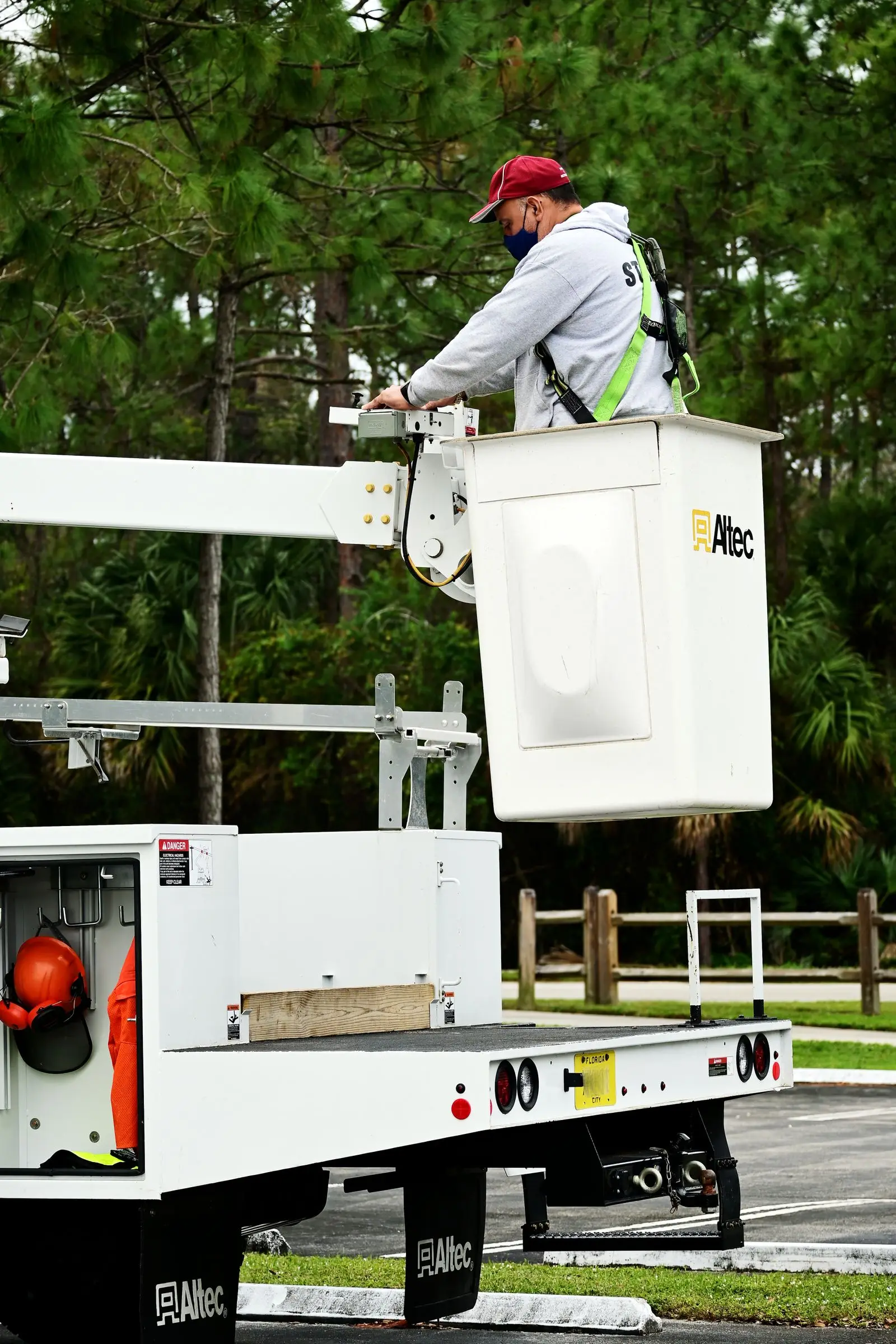
Why you keep your distance
Trees conduct electricity
Live wood is full of water. A branch on a primary line can energize the whole tree and the ground around it.
Lines look dead when they are not
A downed line may not spark or hum. Automatic equipment can re-energize it without warning.
The ground can be live
Current spreads through wet soil. That is why the safe distance is measured in tens of feet.
Fences and puddles carry it
A metal fence touching the tree can be energized far from the contact point.
Generators backfeed
A neighbor's improperly connected generator can send power into lines the utility has shut off.
Which line is whose
From the top of the pole downward, lines differ in voltage and in who is responsible for trees near them.
| Line | Where it is | Tree clearance responsibility |
|---|---|---|
| Primary distribution | Top of the pole, running pole to pole | The utility. It prunes on a cycle and clears storm damage. |
| Secondary | Lower on the pole, pole to pole | Usually the utility |
| Service drop | From the pole to your house | Generally the property owner, with the utility disconnecting it for the work |
| Mast, weatherhead and meter base | Attached to your house | The owner. Repairs need a licensed electrician. |
| Cable and phone lines | Lowest on the pole | The communications company. Low voltage, but treat any unknown line as live. |
Policies vary by utility. Call yours to confirm what it handles.
What is the 10-foot rule?
Federal workplace safety rules require unqualified workers and their tools to stay at least 10 feet from overhead lines of up to 50,000 volts, and farther from higher voltages. Only line-clearance qualified arborists may work closer.
- For homeowners
- Never prune, climb or use a ladder or pole saw within 10 feet of a line. Aluminum ladders and wet pole saws are common causes of electrocution.
- For ordinary tree crews
- They must keep the same distance, which is why a tree in the lines waits for the utility or a qualified line-clearance contractor.
- For the service drop
- Ask the utility for a temporary disconnect or line cover. Most will do it at no charge, with notice, so the tree work can proceed safely.
What to do, by situation
- Act now
A line is down, sparking or burning
Call 911 and the utility. Keep everyone at least 35 feet back.
- Act now
A tree or large limb is resting on pole-to-pole lines
Report it to the utility as a hazard. Do not hire anyone to remove it.
- Act now
A limb pulled the service line or mast off the house
Call the utility to disconnect, then an electrician for the mast and a tree service for the limb.
- This week
Branches are growing into the primary lines
Request trimming from the utility. It is their job and there is no charge.
- This week
Branches are rubbing the service drop to your house
Arrange a utility disconnect, then have a tree service prune for clearance.
- Plan it
You are planting a tree
Keep tall-growing species well away from overhead lines. Choose small trees under them.
After the utility has been
Utility crews restore power. They cut what they must to free the line and usually leave the wood where it falls. Cleaning up the rest of the tree is the owner's job.
Utility pruning is done for clearance, not appearance. Directional pruning that leaves a V or an L shape around the wires is standard practice and is better for the tree than topping it under the line, though it can look severe at first.
If a tree near lines needs to come out entirely, some utilities will remove it, or take it down to a safe height and leave the rest to you. Ask. Otherwise a tree service coordinates with the utility, and the general approach is described under tree removal.
Power line questions
Who do I call when a tree falls on a power line?
Your electric utility's outage or emergency number, and 911 if the line is down, sparking or anyone is in danger. Do not call a tree service first. They cannot start until the utility clears it.
Will the power company remove the whole tree?
Usually not. Utilities cut what is necessary to restore service and leave the debris. Some remove hazard trees that threaten their lines, by their own choice.
Am I responsible for trimming around the wire to my house?
In most service areas, yes. The owner maintains vegetation around the service drop. Ask the utility to disconnect or cover the line before any work is done.
Is the cable line dangerous?
Communication lines carry low voltage, but a fallen power line can be touching them out of sight. Treat every downed line as energized.
This guide is general information, not professional, legal or insurance advice. Tree conditions, local rules and policy terms vary. Have a qualified arborist inspect the tree, and confirm regulations and coverage with your city and insurer.
Want someone to look at the tree?
Call to be connected with an independent tree service company in your area, or leave your number for a callback.
(888) 555-0142Call availability varies by area and time of day
Limbwright is a referral service. Your call or request goes to an independent tree service company that sets its own prices and schedule. Ask for proof of insurance and a written scope before work starts. How this works
Request a callback
Leave a number and a tree service provider in your area will call you.