
Atlanta, Georgia
Tree Removal and Tree Service in Atlanta
Inside the City of Atlanta, nearly every mature tree on private property needs a permit before removal, including dead ones. The canopy the ordinance protects is unusually tall, and when it fails it tends to land on a house.
- Counties
- Fulton and DeKalb
- Tree permits
- City of Atlanta Arborist Division, Office of Buildings
- Key local rule
- Permit required for hardwoods 6 inches and larger and pines 12 inches and larger in diameter
- Electric utility
- Georgia Power
- Main hazards
- Tropical storm remnants, spring squall lines, saturated clay
Atlanta's tree ordinance at a glance
The City of Atlanta's Tree Protection Ordinance applies to private property. A permit is required to remove, destroy or injure a hardwood tree 6 inches or more in diameter at breast height, or a pine 12 inches or more.
Dead, dying and hazardous trees are not exempt. They are handled through a permit from the Arborist Division that carries no fee, and a city arborist may inspect the tree. Healthy trees are much harder to get approved and involve posting and replacement or recompense.
The ordinance covers the city only. Addresses in unincorporated DeKalb or Fulton County, Sandy Springs, Brookhaven, Decatur and other suburbs follow different rules. The step-by-step version is on our tree removal in Atlanta page.
The city in a forest
City-commissioned canopy studies have put tree cover at close to half of Atlanta's land area, among the highest for any large American city. Much of that canopy is on residential lots, and many of the trees are 80 to 120 feet tall.
The terrain adds to the challenge. Intown neighborhoods such as Morningside, Virginia-Highland, Grant Park and Candler Park have steep, narrow lots, houses built close together and backyards that drop to creeks. Trees often cannot be reached by a bucket truck, and wood has to be carried uphill or lifted out by crane.
Georgia red clay holds water. After several days of rain the upper soil turns plastic, and tall trees with wide, shallow root plates go over in winds they would normally shrug off.
Atlanta's problem trees
- Water oak
- The classic Atlanta house-crusher. Fast-growing, hollow by 60 to 80 years, and very large.
- Loblolly pine
- Snaps mid-trunk or uproots. Killed in groups by pine beetles after drought or lightning.
- Tulip poplar
- Often the tallest tree on the lot. Soft wood and heavy limb drop.
- White oak
- Long-lived and valued. Declines after root disturbance from construction.
- Southern red oak
- Root and butt rot can leave a full green crown over a decayed base.
- Bradford pear and Leyland cypress
- Short-lived landscape trees that split or blow over.
Storms Atlanta remembers
Atlanta sits 250 miles from the Gulf, and tropical systems still arrive with force. Irma in September 2017 prompted the first tropical storm warning ever issued for the city. Zeta crossed north Georgia before dawn on October 29, 2020, moving fast enough to keep its wind, and brought trees down on homes across the metro area.
Spring squall lines and the occasional tornado do similar damage on a smaller footprint. Ice is less frequent but hard on pines.
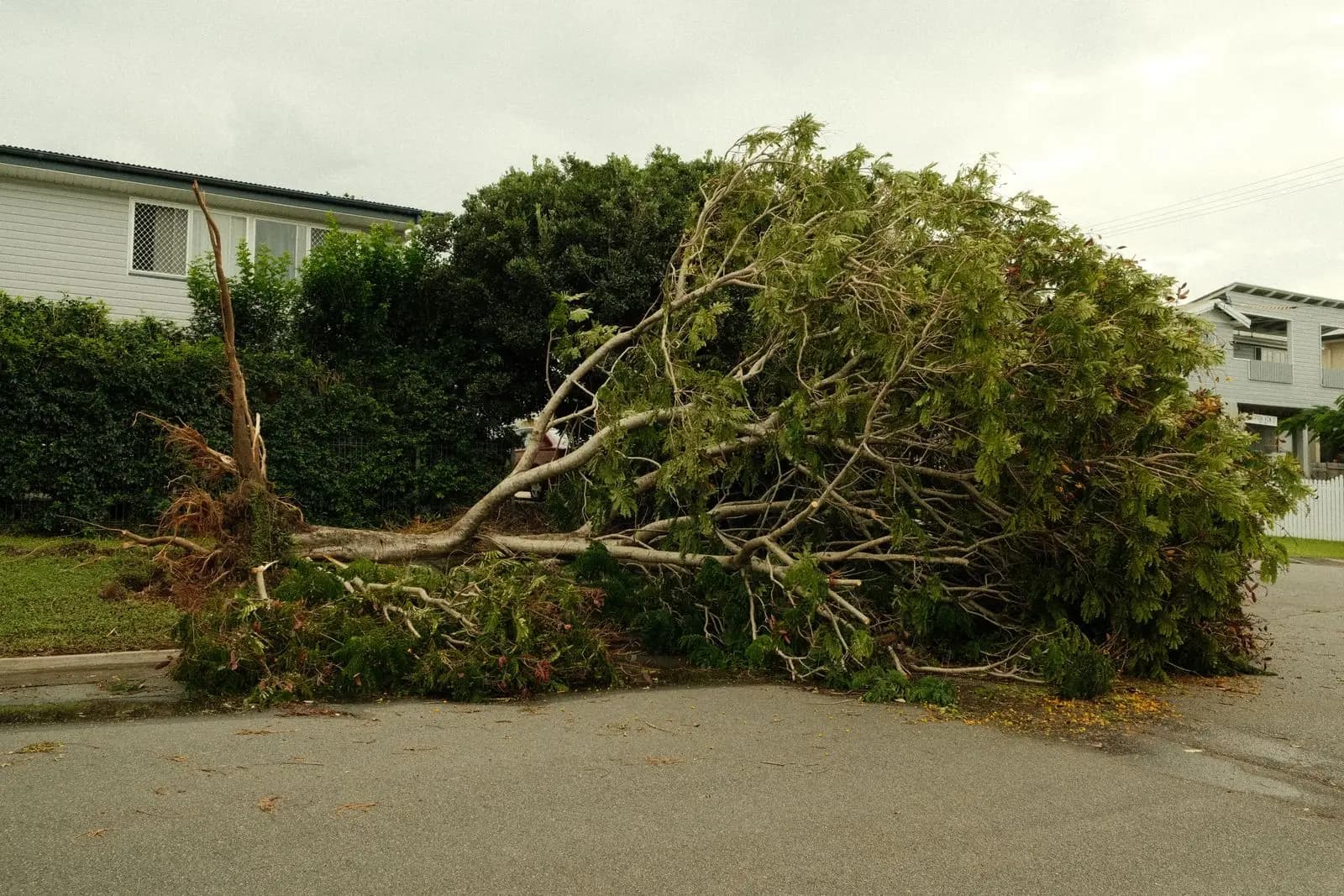
A common thread runs through all of them: the failures are concentrated in trees that already had a defect. Hollow water oaks, beetle-hit pines and trees with cut roots account for a disproportionate share of what falls.
Signs a big Atlanta oak is declining
Root and butt rot are widespread in the city's older oaks. The crown can stay green until the day the tree falls.
Mushrooms at the base in fall
Honey-colored clusters or large shelf fungi on roots or lower trunk.
Dead branches at the top
Dieback that begins in the upper crown.
Bark falling from the lower trunk
With crumbly or stringy wood beneath.
A cavity between root flares
Probe it. Soft, wet wood means active decay.
Small or pale leaves
Compared with other oaks of the same kind on the street.
What to do with an Atlanta tree, by situation
- Act now
The tree is on the house, or is cracking and about to fall
Photograph it and call for emergency removal. The city allows imminent hazards to be addressed, with documentation.
- This week
The tree is dead, dying or clearly defective
Have the company or an arborist file for the no-fee dead, dying or hazardous permit before work.
- This week
You are unsure whether it is hazardous
Get a tree risk assessment. It also supports the permit request.
- Plan it
The tree is healthy and you want it gone
Expect a longer process with posting and recompense, and a real chance of denial. Consider pruning.
Services for Atlanta properties
Atlanta tree questions
Do I need a permit to remove a dead tree in Atlanta?
Yes, if it is a hardwood 6 inches or more in diameter or a pine 12 inches or more. The dead, dying or hazardous tree permit carries no fee and is obtained from the Arborist Division.
What is the fine for cutting a tree without a permit in Atlanta?
The ordinance sets fines per tree, and they can reach into the thousands for repeat or large violations, plus recompense. Both the owner and the tree company can be cited.
My address says Atlanta. Am I in the city?
Not necessarily. Many Atlanta mailing addresses are in unincorporated Fulton or DeKalb County or in other cities. Check the city's property lookup or your tax bill before assuming which ordinance applies.
Can I prune without a permit?
Routine pruning that does not injure the tree does not need a removal permit. Topping or cutting that destroys the tree counts as removal under the ordinance.
Reach a tree service in Atlanta
Call to be connected with an independent tree company that works in the Atlanta area, or leave your number and one will call you back.
(888) 555-0142Call availability varies by area and time of day
Limbwright is a referral service. Your call or request goes to an independent tree service company that sets its own prices and schedule. Ask for proof of insurance and a written scope before work starts. How this works
Request a callback
Leave a number and a tree service provider in your area will call you.