
Decision guide
Can a Storm-Damaged Tree Be Saved?
Updated · Limbwright editorial
Short answer
A storm-damaged tree can usually be saved if its main trunk and leader are intact, at least half its crown remains, and the roots have not lifted. Trees with a split trunk, a heaved root plate or most of the crown gone should generally be removed.
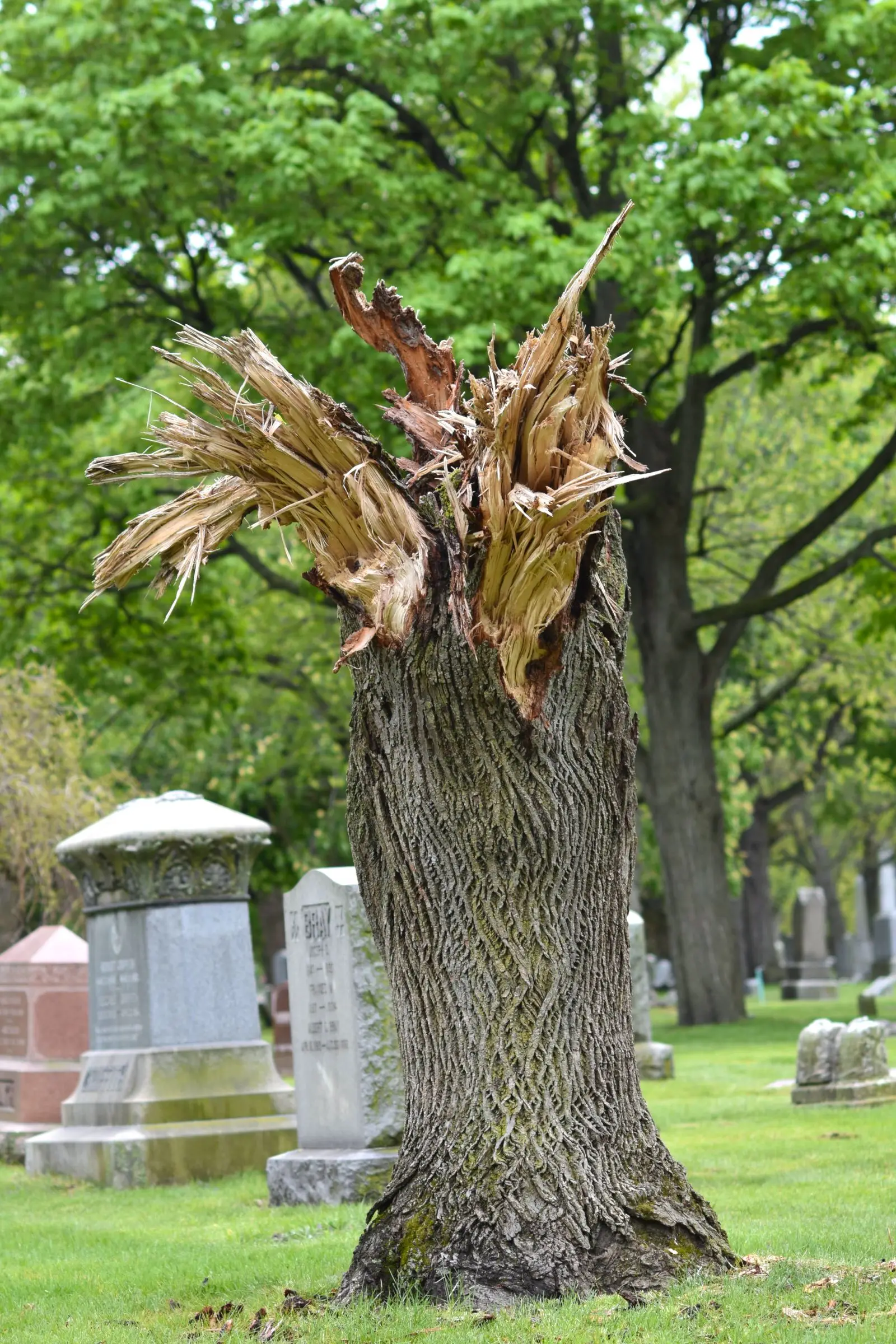
Six questions to ask about a damaged tree
These follow the guidance long published by forestry extension services for homeowners after storms.
Was the tree healthy before?
A vigorous tree with no prior decay recovers far better than one already in decline.
Are the major limbs still there?
The more large scaffold limbs lost, the harder the recovery.
Is the leader intact?
Loss of the main upward stem matters most in single-leader species such as pines.
Is at least half the crown left?
A tree needs enough foliage to feed itself through the next season.
How big are the wounds?
Small wounds close. A wound wider than a third of the trunk's circumference rarely does.
Are there branches to rebuild from?
Remaining limbs in good positions can fill in the gaps over time.
Keep, wait or remove
| Verdict | The tree looks like this | What happens next |
|---|---|---|
| Keep | Minor branch breakage. Leader and structure intact. | Clean pruning cuts on broken stubs. No other treatment. |
| Keep, with work | Several large limbs lost, but more than half the crown and the leader remain | Corrective pruning now, restoration pruning over three to five years |
| Wait and see | About half the crown lost on a valuable, previously healthy tree | Remove hazards, then reassess after one or two growing seasons |
| Remove | Trunk split, leader gone from a conifer, root plate lifted, or more than half the crown lost | Schedule storm damage tree removal |
What not to do after a storm
Do not top the tree
Cutting everything back to stubs to "even it out" removes the foliage the tree needs and guarantees weak regrowth.
Do not rush to remove
A tree that looks terrible in the first week can look acceptable in two years. Unless it is hazardous, there is time.
Do not paint the wounds
Wound dressings do not help closure. The exception is oaks in oak wilt regions, where cuts are painted immediately.
Do not fertilize heavily
Pushing growth on a tree with a reduced root or crown system adds stress.
Do not leave torn stubs
Ragged breaks hold water and decay. Have them recut to a branch union.
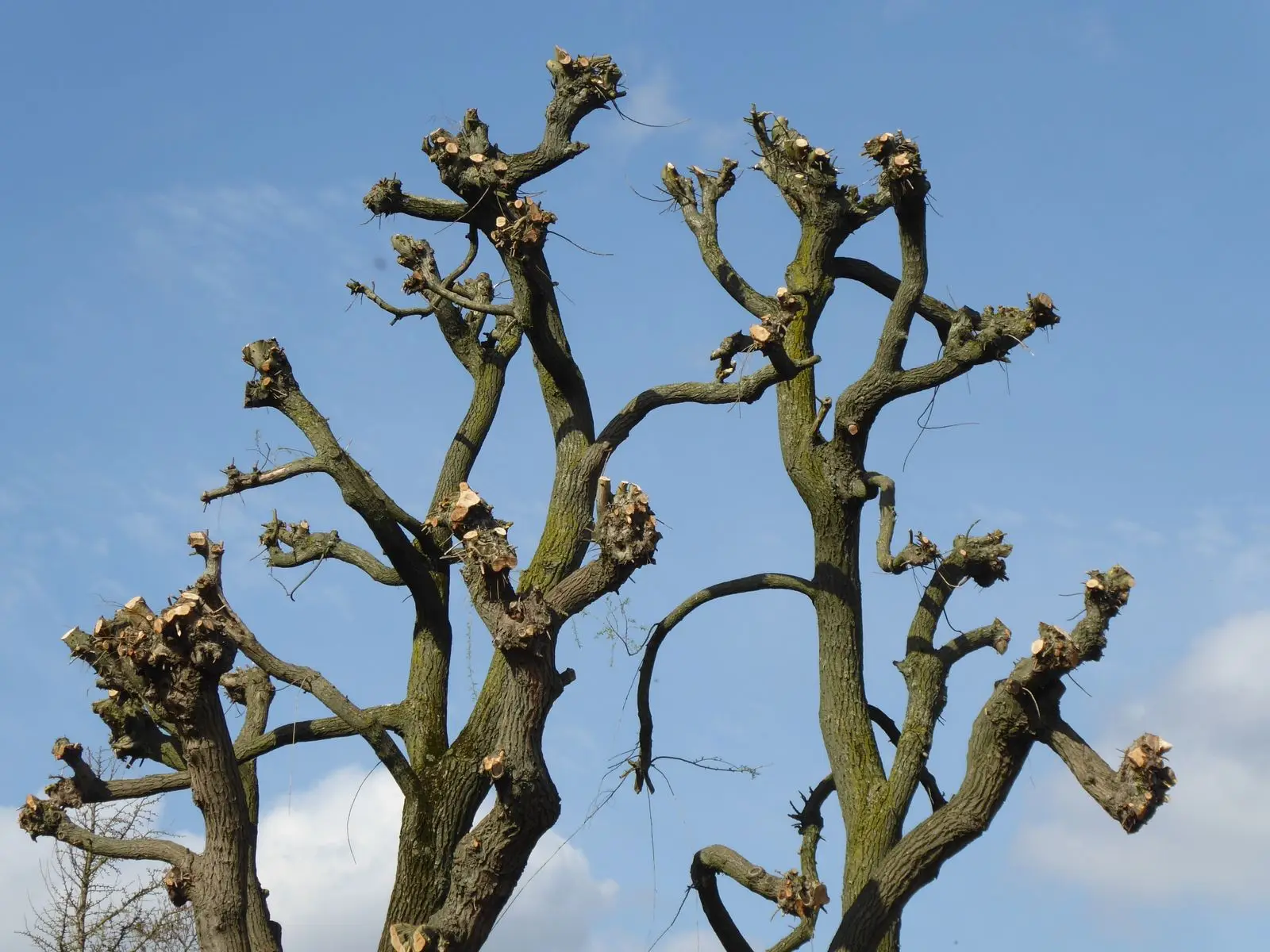
What recovery looks like
In the first season after losing limbs, a healthy tree throws dense clusters of shoots around the wounds and along the remaining branches. It looks untidy. Those shoots are doing the work of rebuilding leaf area, and they should mostly be left alone.
After two or three years, an arborist selects the best-placed shoots to become new branches and removes the crowded and weakly attached ones. That selection is repeated once or twice more. This is restoration pruning, and it is how a broken crown becomes a sound one.
Wounds close from the edges at a rate that depends on the tree's vigor. Small ones seal in a few years. Large ones may never close completely, and those are checked for decay at each visit.
Species that recover well, and species that do not
- Good recovery
- Oaks, elms, bald cypress, sycamore and most maples compartmentalize wounds well and resprout vigorously.
- Moderate
- Pecan, ash and hackberry resprout readily, but large wounds decay.
- Poor structure after damage
- Pines, spruces and firs that lose the leader do not regain a normal form.
- Usually not worth restoring
- Bradford pear, silver maple, Siberian elm and willow fail repeatedly once broken.
- Palms
- Survive if the single growing bud at the top is alive. A new spear leaf within a few months is the sign.
Storm-damaged tree questions
Can a split trunk be bolted back together?
Occasionally, on a valuable tree with a fresh, clean split, an arborist can install through-rods and cables. It needs ongoing inspection and is not suitable where the tree stands over a house.
How long should I wait before deciding?
If the tree is not hazardous, one full growing season shows how strongly it responds. Hazards over structures and walkways should be dealt with immediately.
Will a tree that lost its top grow a new one?
Hardwoods often form new leaders from side branches. Conifers such as pine generally do not regain a strong central leader.
Should a professional inspect trees that look undamaged?
After a severe storm, yes, for large trees near the house. Cracks, twisted limbs and root movement are easy to miss. A risk assessment covers this.
This guide is general information, not professional, legal or insurance advice. Tree conditions, local rules and policy terms vary. Have a qualified arborist inspect the tree, and confirm regulations and coverage with your city and insurer.
Want someone to look at the tree?
Call to be connected with an independent tree service company in your area, or leave your number for a callback.
(888) 555-0142Call availability varies by area and time of day
Limbwright is a referral service. Your call or request goes to an independent tree service company that sets its own prices and schedule. Ask for proof of insurance and a written scope before work starts. How this works
Request a callback
Leave a number and a tree service provider in your area will call you.