Seattle · Removal
Tree Removal in Seattle
On a developed Seattle lot with no construction planned, you can remove trees under 6 inches freely, up to two Tier 4 trees in three years, and larger trees only if they are hazardous and the city approves. This page walks through each case.
Call availability varies by area and time of day. Calls are answered by an independent tree service provider.
Can this tree be removed? Start here
Measure the trunk 4.5 feet above the ground, then find your row.
- Plan it
Under 6 inches in diameter
Not regulated by the tree code on most lots. Check for critical-area restrictions on slopes and shorelines.
- Plan it
6 to 12 inches (Tier 4)
Up to two may be removed in any three-year period in Neighborhood Residential, lowrise, midrise, commercial and Seattle Mixed zones.
- This week
12 to 24 inches (Tier 3)
Removal is prohibited unless the tree is hazardous or an emergency, with SDCI approval.
- This week
24 inches and larger, a grove, or a listed species (Tier 2)
Same prohibition. Hazard removal needs documentation and approval.
- This week
A designated heritage tree (Tier 1)
May not be removed unless hazardous or in an emergency.
- Act now
Any size, and it is failing right now
Emergency action is allowed. Photograph it and notify SDCI afterward.
What "hazardous" has to mean
The city does not accept a tree being tall, messy or close to the house as a hazard. The standard is a risk assessment showing a likely failure and a target that cannot reasonably be moved.
In practice that means a written assessment by an arborist holding the ISA Tree Risk Assessment Qualification, using the standard form, with photos of the defect. Typical qualifying findings are advanced root or butt decay, a cracked or split trunk, an active lean with root plate movement, or a dead tree.
SDCI also looks at whether pruning or another measure could reduce the risk enough. If it can, removal may be refused. This is why a tree risk assessment comes before the removal quote, not after.
The approval sequence
Hire a registered provider
Check SDCI's Tree Service Provider Registry. Unregistered companies may not do commercial tree work in the city.
Assessment and application
The arborist's report goes to SDCI with the hazardous tree removal application.
Public notice
Notice of the planned work is posted in advance, on site and online, for the period the code requires.
Removal
Work proceeds after approval and the notice period.
Replacement
Tier 1, 2 and 3 removals generally carry a replanting requirement or a payment in lieu.
Penalties, slopes and street trees
Illegal removal of a regulated tree can bring substantial penalties under the code, scaled to the size of the tree, and both the owner and the tree service can be held responsible.
Environmentally critical areas add another layer. On steep slopes, in landslide-prone areas, and near streams, wetlands and shorelines, vegetation removal is restricted at any size and may require a geotechnical report.
A tree in the planting strip is a street tree under Seattle Department of Transportation rules. Removal needs an SDOT permit and is approved only for limited reasons.
When removal is refused: what else works
The complaint
- Needles and cones in the gutters
- Too much shade on the garden or roof
- Branches over the house
- Worry about a tall conifer in wind
- Roots lifting a walkway
The permitted response
- Gutter guards. Not a tree issue in the city's view.
- Crown raising and selective thinning within pruning standards
- Clearance pruning and end-weight reduction
- A risk assessment. Most healthy firs rate low.
- Root pruning with an arborist's guidance, or rerouting the walk
Proper pruning solves most of what Seattle owners want removal for, and it does not need approval.
How a tall conifer comes down on a Seattle lot
Once a removal is approved, the physical job is usually a climb. A 110-foot Douglas-fir between two houses has no drop zone, and backyards are seldom reachable by bucket truck.
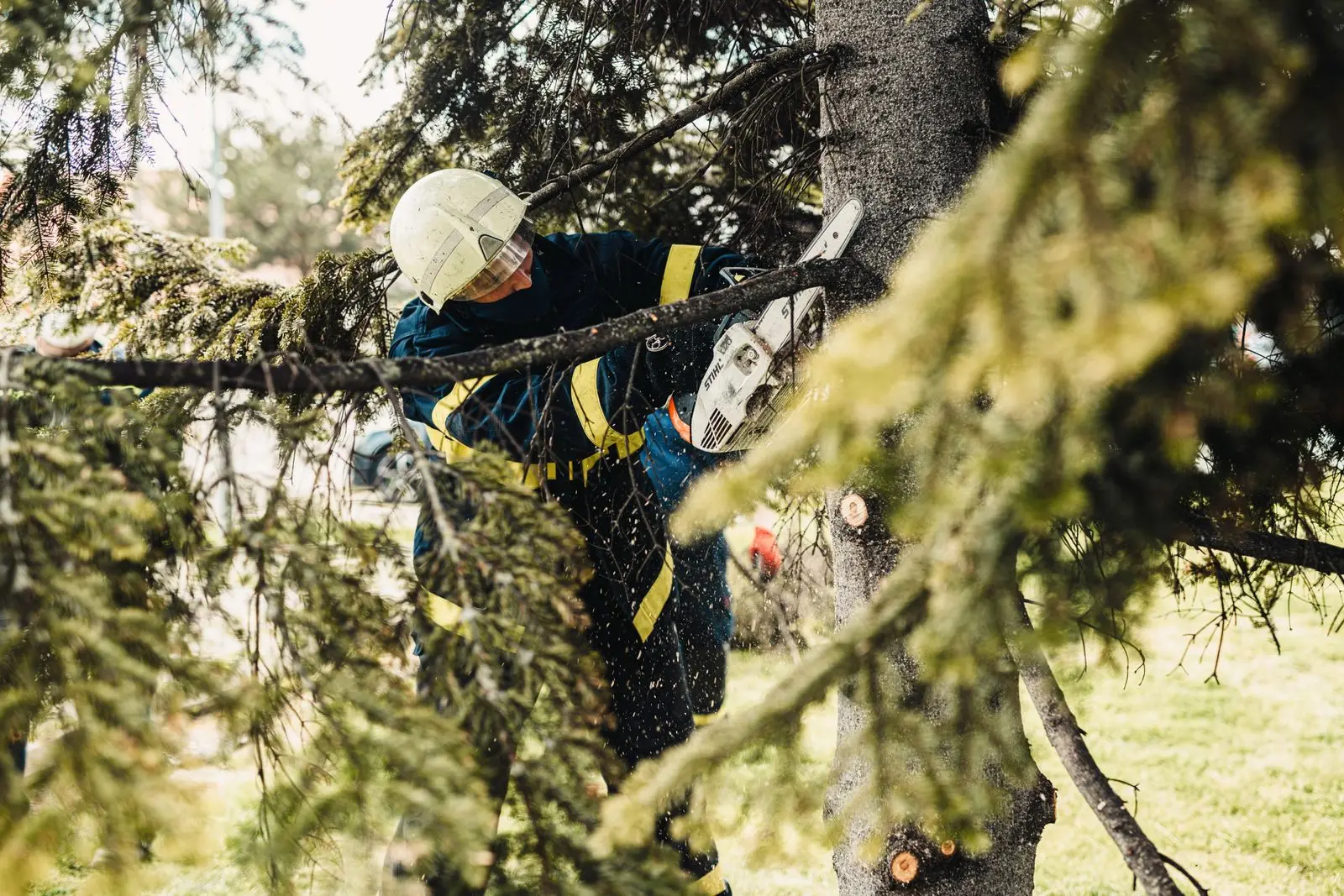
The climber ascends, removes limbs on the way up, then works back down taking the trunk in short sections. Pieces are lowered on a rope or, where there is a small clear patch, dropped onto protective mats. A crane in the street speeds this up when the reach allows and SDOT issues a street-use permit.
Wood is heavy and exits by stairs, side yards or over the house. Expect a large crew, a chipper at the curb and, for big trees, a log truck.
Cost factors specific to Seattle
For national height-based ranges see the tree removal cost guide. Seattle removals tend to run high.
- Tree height
- Native conifers are commonly taller than the top band in national price charts.
- Assessment and permitting
- The arborist report and application are separate costs from the removal.
- Replacement trees
- Planting or in-lieu fees are part of the total.
- Access
- Hillside lots with stair-only access mean hand-carrying.
- Street use
- Crane or chipper setups in the street may need a permit and traffic control.
Seattle removal questions
How do I know which tier my tree is?
Measure diameter at 4.5 feet. Six to under 12 inches is Tier 4, 12 to under 24 is Tier 3, and 24 or more is Tier 2. Some species reach Tier 2 at smaller sizes, groves count as Tier 2, and designated heritage trees are Tier 1.
Can I remove a tree to build an ADU or addition?
Development changes the rules. Removal of larger trees may be allowed where needed to achieve permitted development, with replacement. That is decided through the building permit, not a standalone tree application.
Is a dead tree automatically approved?
A dead regulated tree qualifies as hazardous in most cases, but documentation and SDCI approval are still required before removal, except in an emergency.
Does my neighbor get a say?
Neighbors are informed through the public notice. They do not approve or veto a hazardous tree removal, but they can report work done without notice or approval.
Tree Removal help in Seattle
Call to be connected with an independent tree company that works in Seattle, WA, or request a callback.
(888) 555-0142Call availability varies by area and time of day
Limbwright is a referral service. Your call or request goes to an independent tree service company that sets its own prices and schedule. Ask for proof of insurance and a written scope before work starts. How this works
Request a callback
Leave a number and a tree service provider in your area will call you.