
Pennsylvania
Tree Removal and Tree Service in Pennsylvania
Pennsylvania means Penn's Woods, and the state is still more than half forest. Its tree work is driven by ice in the southeast, sudden wind in the west, and a run of invasive insects that began with emerald ash borer and continued with spotted lanternfly.
Ice in the east, wind in the west
On February 5, 2014 freezing rain coated the Philadelphia suburbs with up to half an inch of ice. Limbs and whole trees came down across Chester, Montgomery, Bucks and Delaware counties, and the regional utility recorded one of the largest outages in its history.
Western Pennsylvania's signature event is more recent. On April 29, 2025 a line of storms hit the Pittsburgh area with gusts measured above 70 mph, toppling trees onto houses and wires and leaving hundreds of thousands without power.
Between those, the March 2018 nor'easters, Sandy in 2012 and regular summer squall lines keep crews busy. Much of the state's housing sits on wooded slopes, and trees there fall downhill onto whatever is below.
Dead ash and hemlock: what to look for
Emerald ash borer reached Pennsylvania in 2007 and has since killed most untreated ash. Hemlock woolly adelgid is doing slower damage to the state tree.
Ash with bark stripped pale
Woodpeckers flake off the outer bark to reach larvae. The tree is heavily infested.
Sprouts from the lower trunk of an ash
The crown is failing and the tree is making a last effort.
Ash that has been dead more than two years
The wood is brittle and may snap under a climber. Expect a lift or crane.
White woolly dots at the base of hemlock needles
Adelgid. Treatable if caught before the crown thins badly.
Quarantines, street trees and shade tree commissions
The Pennsylvania Department of Agriculture maintains a spotted lanternfly quarantine covering most of the state's counties. It does not stop a homeowner from removing a tree, but businesses that move wood, brush and equipment out of the zone need a permit and must inspect loads. A tree service working in the quarantine should have one.
Pennsylvania has no state arborist license and no statewide removal permit. Local control runs through borough and township shade tree commissions, which typically govern trees along streets and sometimes on private lots.
In Philadelphia, the tree between the sidewalk and curb is regulated by Parks and Recreation. Pruning or removing a street tree requires a city permit and an approved contractor, even though the adjoining owner is responsible for the sidewalk around it.
Pennsylvania trees and their usual trouble
| Tree | Where it is common | Usual trouble |
|---|---|---|
| Eastern hemlock | Shaded slopes and stream valleys statewide | Adelgid and elongate hemlock scale |
| White ash | Woodlots and older yards | Almost all dead or dying from borer unless treated |
| Norway maple | City and borough streets | Girdling roots, trunk decay, heavy limbs over parking |
| Tulip poplar and red oak | Suburban lots carved from forest | Tall trees on slopes above houses |
| Tree-of-heaven | Fence rows, alleys, rail lines | Invasive, brittle, and the lanternfly's preferred host |
Hillside removals in Pittsburgh and the ridges
- No room for a truck
- Many houses are reached by steps or a steep drive. Brush is carried or winched out by hand.
- Trees above the house
- A tree upslope has to be rigged so each piece swings away from the roof.
- Unstable ground
- Slopes around Pittsburgh are prone to slides. Removing every tree from a steep bank can make that worse, so stumps are often left to hold soil.
- Cranes from the street
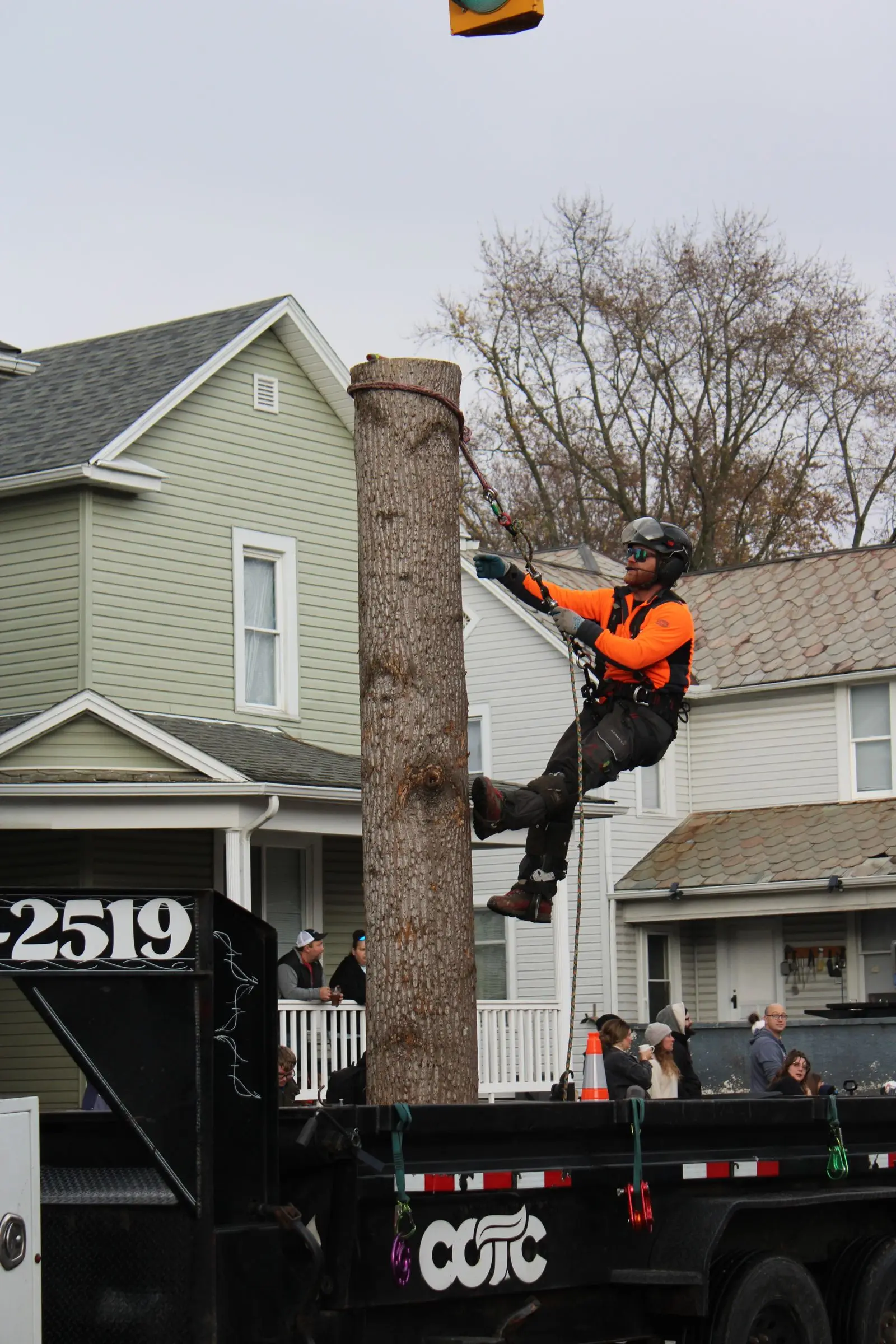
- Sometimes the only practical method, and it needs a road closure.
Treat the ash or take it down
Treatment makes sense when
- The crown is still mostly full
- The tree shades the house or anchors the yard
- You accept re-treatment every two to three years
- An arborist confirms the trunk is sound
Removal makes sense when
- More than about a third of the crown is gone
- Bark is splitting and woodpeckers are working the trunk
- The tree is small or poorly placed
- It leans over a house, drive or play area
Delay costs money either way. A live ash can be climbed and removed conventionally. A long-dead one cannot. See dead tree removal.
Pennsylvania tree service questions
Do I have to remove trees because of spotted lanternfly in Pennsylvania?
No. The quarantine controls the movement of materials, not removal. Taking out tree-of-heaven helps reduce numbers, but healthy maples and other hosts normally stay.
Is a permit needed to cut down a tree in Pennsylvania?
Not from the state. Street trees are regulated in most boroughs and cities, and some municipalities protect private trees. Ask your borough or township office.
Why is removing a dead ash so expensive?
Dead ash loses strength fast and breaks unpredictably. Climbers will not tie into it, so the job needs a bucket truck or crane, and sometimes a road closure.
Who is responsible for a street tree in Philadelphia?
The city regulates it, and work requires a permit from Parks and Recreation. The property owner is generally responsible for the sidewalk and can request pruning or removal through the city.
Tree service in Pennsylvania, by phone
Call to be connected with an independent tree company serving your part of Pennsylvania, or leave your number for a callback.
(888) 555-0142Call availability varies by area and time of day
Limbwright is a referral service. Your call or request goes to an independent tree service company that sets its own prices and schedule. Ask for proof of insurance and a written scope before work starts. How this works
Request a callback
Leave a number and a tree service provider in your area will call you.